
Knowledge Creation
Part 1: A Constructor Theory of Explanatory Knowledge?

The Mind as Unique Software
Knowledge - explanatory knowledge in particular - is a curious thing. It is at once an abstraction (as numbers, “Platonic shapes” or concepts like “justice” and so on are abstractions) but unlike those things knowledge, to count as knowledge, must be represented (“instantiated” as we say) physically somewhere (in a “physical substrate”). Note the distinction here between purely abstract numbers - which can indeed exist whether or not we ever use numerals to represent them (-5, 0, 1, π and so on are not numbers, strictly, but representations of them that we call numerals.) The overwhelming majority of numbers that exist will never be represented as numerals.
Explanatory knowledge is different. It is at once an abstraction (it is “abstracted” from its initial instantiation so to speak) but it makes no sense to speak of an explanation as having an existence independent of the physical world. Even explanations of fictional worlds (like for example the Star Wars or Harry Potter worlds) have to be represented in our physical reality somewhere. Even the initial imaginings of George Lucas and J. K. Rowling began by being represented in their respective brains. But once there, they were then committed to paper, and then film and so on. As it is for explanations of the actual physical world too.
Let us underscore that by repeating it: the same explanation (or explanatory knowledge - I use these terms interchangeably) - might first appear as a pattern of neuronal firings in a brain (or thoughts in a mind) and then as ink or paper, or points of light coming from pixels on an LCD screen, and then encoded as voltage potentials themselves representing binary 0s and 1s inside the electronics of a computer and later, perhaps read aloud and becoming sound waves in the air before reaches the ears of another person. These various physical forms can contain the same useful information (knowledge) being copied from one form to another. The term generally used for this phenomenon is “substrate independence”. While the physical form that the knowledge takes on may look wildly different (voltage potentials in computer circuits compared to the vibrating vocal chords of a person speaking aloud) the knowledge itself has the same content; it refers to the same things (whether in physical, abstract or even fictional reality).
But how does explanatory knowledge arise in the first place? Now here I am not asking “What causes the brain, neurones or synapses to do this or that?” - this is not a question of neuroscience. And this is because questions about the origins of explanations are not questions about the details of particular substrates. What we are seeking are explanations of explanations in terms of the origins of ideas. Ideas do not come from nowhere: they are generated in minds given pre-existing ideas. This present piece assumes that the ancient idea, still popular in some circles of “tabula rasa” - the blank slate - is false. Nonetheless we are going to explore the possibility that ideas, and in its turn explanatory knowledge, contains a very real element of creation - and possibly creation ex-nihilo.
When it comes to explanations we say that individual people are creators of explanatory knowledge - and uniquely so. Indeed people are “universal explainers” as David Deutsch first outlined in “The Beginning of Infinity”. But what is the nature of this mind that is the entity responsible for the creation of explanatory knowledge? What qualities does it posses that allow for a literal kind of creation?
We take the assumption seriously that the so-called “computational thesis” of the mind is true. That is: the mind must be a kind of software running on the hardware that is the brain. The brain is performing computations. That is required by the so-called Church-Turing-Deutsch (CTD) principle. What this means is that whatever the brain is doing can be simulated by a universal computer. This is because the CTD principle states that literally any and every physical process that occurs anywhere in the universe anytime, ever can be simulated and hence replicated by a computer. The only alternative is to simply assert (in contradiction to this principle of physics) that some processes are not computable or cannot be simulated. But as Karl Popper and David Deutsch have both observed: the denial of a good explanation (like the CTD principle) is not itself a good explanation. One would need to provide a robust alternative. And arguing that the human brain is a special case is an ad-hoc, one-off denial of an otherwise physical theory that has great reach and explanatory power.
What kind of software is it though? No one yet knows. The solution to that will be the solution to what it takes to encode an artificial person (sometimes, and sometimes not, these days referred to as Artificial General Intelligence or AGI). But this “mind-software” - can it run on substrates other than the wet-ware that is the human brain? Presumably so: that too is required by the universality of computation (the aforementioned Church-Turing-Deutsch Principle). But is there a minimum or even maximum bound within which the program must run lest it fails to remain a “creative” program? How much memory is required to store it? If a person is a mind, and a mind is able to learn, does the capacity to generate new explanations change over time? If so how? Does the underlying code get re-written? Is the “creative” program of an infant different to that of an 80 year old? Again, these are all open questions. We do not know how minds create knowledge, all we know is that they do.
Creating and Discovering
The notion of “creation” has gradually, since the Enlightenment and Scientific Revolution, been thought of by scientifically minded rationalists and analytical philosophers as an uncomfortable hangover of a more superstitious time. Typically regarded as a term of derision in both biological and cosmological circles it is now deemed by anyone lacking a religious bent as little more than a placeholder for “a process we do not yet understand”. Creationism is, after all, the doctrine that an intelligent creator set in motion events that led to - first, the origins of the cosmos itself and then later, with another intervention, the miraculous appearance of life in all its diverse forms.
Traditionally, creativity is most commonly associated with fields such as the arts - whether fine or modern, literary or dance and more besides. And to some extent in the sciences - but only with reluctance. Many wish to describe the work of Albert Einstein for example as having discovered General Relativity rather than having created that theory. And likewise Charles Darwin uncovered evolution by the process of natural selection (so it goes by observing the beaks of finches and the variations among giant tortoises) rather than having created the explanation. This notion that theories or explanations are discovered rather than created harks back to an ancient idea that people “reading from the book of nature” - going back to at least Saint Augustine in the 4th Century and later popularised by Galileo Galilei in 1623 in his work The Assayer. Galileo may have been speaking metaphorically when he wrote words to the effect that the book of nature “is written in the language of mathematics”. But if he was not - and he was speaking literally as many even today seem to be - he has confused the subject matter of reality with our knowledge of reality (what is written in the book we author about reality).
Let us take seriously therefore an important distinction. Creation is about bringing something into reality that did not have an existence before it was created. Yes, the clay may have been there, but the pot from which it was forged was not. Not until a person moulded, glazed and set it in a kiln. This is quite unlike the clay itself - which was indeed discovered by the person in the ground. Clay is found across the Earth, often in riverbeds, formed by the chemical weathering of igneous (and sometimes metamorphic) rocks. It is there to be discovered. No one needs to invent it, manufacture it or create it. But a pot, cup or bowl? Those must be created. And how? Only by knowing how. But that know how must itself be created first. A person discovers that which was already there. A person creates that which was not already there.
There is therefore a strict divide between discovering and creating. And the most important kind of creation is that engaged in by people: the creation of knowledge. And the most important kind of knowledge? Explanatory knowledge. And the most significant kind of explanatory knowledge is that found in our deepest subjects of mathematics, science, philosophy, morality and so on for those are subjects about objective reality (both physical and abstract). By creating explanatory knowledge we come to discover ever more about objective reality.
We shall remain with our clay pot example for another moment. Clay pots, it turns out, are a great source of inspiration in archeology and history more broadly. They can be preserved for millennia and diverse civilisations across the globe have tended to develop their own unique styles of pots. Here for example is a (rather famous) Korean Clay Pot from the Bronze Age - around the 4th century BCE and located in The Metropolitan Museum of Art in New York.
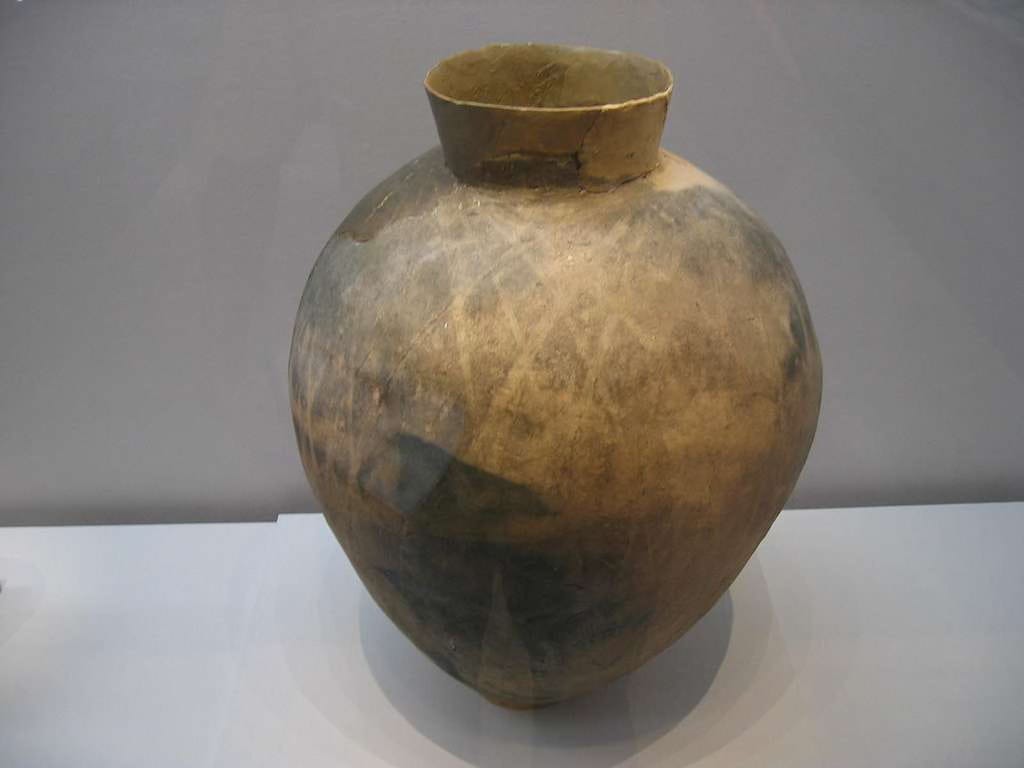
Korean pots have been prized historically for their excellence and their diversity. Historically although the Japanese, for example, looked down on the Koreans in almost every other respect (attempting to invade multiple times thinking Korean society far less civilised - notably in the last decade of the 1500s) - they always respected Korean potters as the best in their known world to the point they kidnapped many. That war which lasted from 1592 to 1598 goes by many names - usually the Imjin War. But it has also been known as “The Pottery War” because of just how prized those pots and their potters were.
In any case, whether Korean or anywhere else, ancient pots could be manufactured because people then knew how to make them. They could teach generation after generation what to do: how to collect the clay itself, which were the best choices of clay, how to keep the clay moist, techniques of moulding and spinning and producing fires and kilns of just the right temperature with just the right fuels and so on. But almost all of that would have been “rules of thumb” - highly inexplicit knowledge. They could not have explained the physical and chemical processes going on in modern scientific terms - not even approximately. They knew nothing of elements, compounds and mixtures - they lacked any kind of language for chemistry except crudely mythological notions. They could not have said what kaolinite was or how it was dehydrated into metakaolin before sintering to form both covalent and ionic chemical bonds before vitrification. But there is indeed a good scientific explanation of all of that process from a soft newly formed clay pot into the hardened useful container that eventually comes out of the kiln.
A modern understanding of the chemistry involved has allowed modern manufacturers of pots, earthenware and ceramics more widely to refine their techniques and improve. One can only imagine how excited Koreans of the 16th century would have been to know these techniques! Instead, progress in pot making was slow. The modern science that explains how pottery works exactly had to likewise be created in the same way the rules of thumb around pot making techniques was created in centuries long gone. That is a process of conjecture and refutation as most clearly and extensively explained by Karl Popper.
Knowledge creation is a very special and important thing in our world. Special because there are not many kinds of “creation” out there. That the universe may have been created at some point (I am not saying this requires an intelligent and all powerful creator, or even any “creator” at all) is one instance. We now know that all life on Earth is created: but again, not by any creator. It is created by a mindless process of evolution through natural selection. But creation it is. Kangaroos were not there at the Big Bang, nor 4 billion years ago on the surface of the Earth and yet now they are. Along with all other life forms. That is creation. And it is a type of knowledge creation. But, as is now becoming common knowledge in some circles, the creation of life via that process has been a mere prelude to what now exists in physical reality: people with their own capacity to create via yet another mechanism. Ideas, memes and knowledge. And, once more, the most important kind of creation is the creation of explanatory knowledge because that entity is what gives people control over the rest of physical reality. Creating explanations provides understanding of physical and other processes. And if we know, for example, the laws governing things like electricity-carrying wires, then we can exploit our knowledge of such laws to create things like electric motors and generators. We can build civilisation. We can engineer wondrous technology. We can move mountains and construct towers into the clouds.
But how precisely does knowledge creation happen in a mind? Is there a physical account of how explanations are generated by people? A heuristic first articulated by David Deutsch in “The Beginning of Infinity” runs thus: “if you can’t program it, you haven’t understood it”. Presently we do not know how our capacity to generate explanations works to that level of fidelity. We only know that we do it, not how. This is equivalent to the fact that we are universal explainers (see my book “The Farthest Reaches” for more on that). We know that we are. We don’t know how we are. This is the rule as we get closer and closer to the edge of what is known by science. For example: dark matter is the name of a problem. It is a short-hand label for the mystery that is why spiral galaxies rotate at the rate they do, or how globular clusters are bound to such galaxies or how galaxies are bound into clusters themselves. All our observations indicate that there is a problem of some kind (be it the missing mass that is “dark matter” or whether it is the laws governing gravity that we understand or perhaps even our observations themselves). We know that the “dark matter problem” is a problem - we do not know why. If we take seriously our present theories of physics as genuine explanations of reality (and in this case that is General Relativity) then what is forced upon us is “missing mass” (or dark matter) - if we do not wish to say “our otherwise good explanation of gravity is, actually, false).
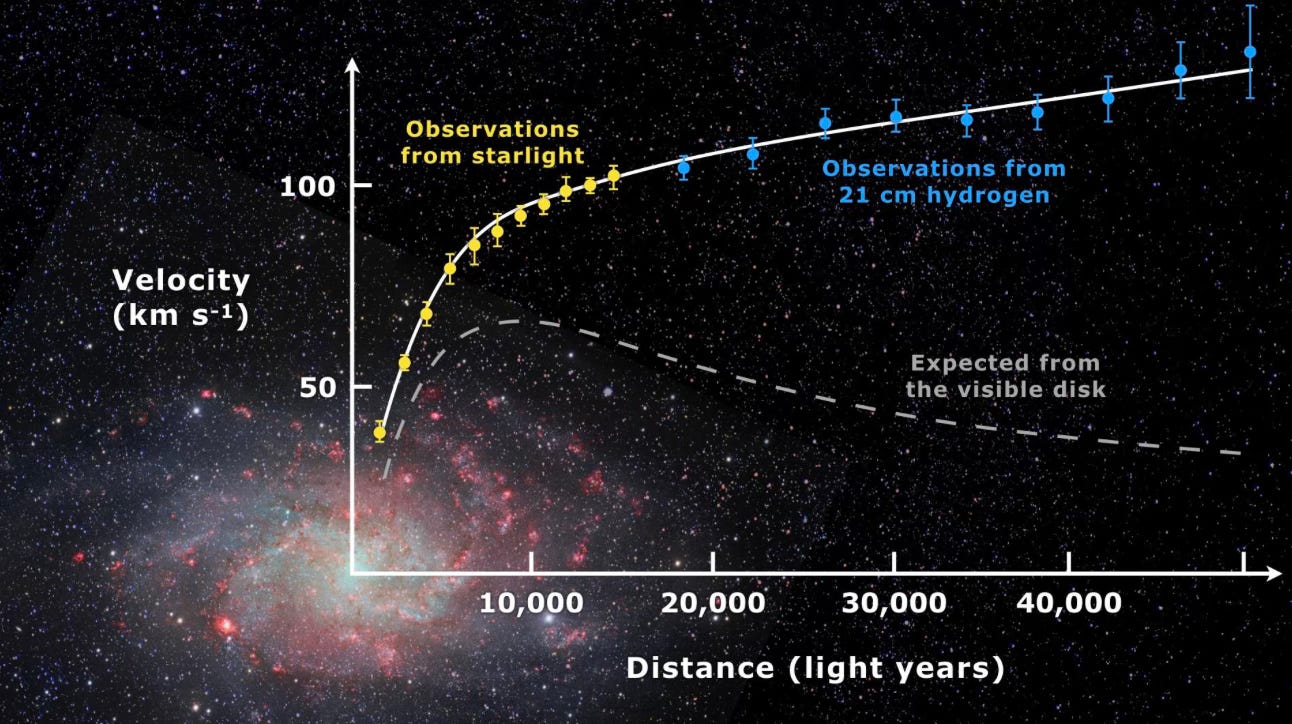
(Galaxy rotation velocities deviate from the mass that is seen).
Put another way: we do not know what should serve as the proper input into a simulation of the motion of a galaxy in order to produce what we do observe (yes, sure we can ad-hoc “add mass” - but where is that mass and what is the nature of it?). Some have claimed recently that David Deutsch’s own criteria for what constitutes a “good explanation” is itself not understood and is therefore refuted. But this is, again, a misconception about the nature of what it means for something to be known. It is again the distinction between knowing that and knowing how. We understand that good explanations are hard to vary but we cannot explain how to further constrain what “hard to vary” means. Among other things this is because we do not (yet) know how to constrain what an explanation is precisely. But we know it when we see it. This is not a slippery way of doing epistemology: it just admits that epistemology - like science and reason more broadly always has open questions and can make progress. It is not a “completed subject area”. My own guess is that a fuller understanding of how the requirement for good explanations to be “hard to vary” works more exactly will require us to also understand what the program for a universal explainer is. Perhaps once we have the answer to one of these things (that a person is a universal explainer, but not yet how, and how it is that a good explanation is hard to vary, but not yet how) we will have the answer to both. But that is just conjecture on my part.
The Successes of Constructor Theory
A new framework in physics has emerged over the last decade. It is known as Constructor Theory and has the feature of formulating laws of physics not in the traditional “initial conditions + laws of motion” way but rather either side of the line drawn by the possible and impossible. As, so far, the prevailing framework in which physics has been conducted since Newton has failed to have much relevance to epistemology and knowledge creation directly, perhaps Constructor Theory can shed light on questions about how explanatory knowledge is created. After all, if as many of us guess, explanatory knowledge will eventually lead to the building of structures which have galactic significance - then physics will need at some point to grapple with such a cosmically powerful entity. We already observe the beginnings of this effect on a global scale and there is no law of physics that say such effects will not continue to grow.
The fundamental idea driving the formation of scientific theories within the Constructor Theory framework is about which transformations are possible and which are impossible. Transformations require a “constructor” hence the name of the theory. Chiara Marletto’s book “The Science of Can and Can’t” gives an excellent overview of the fundamentals. And for a more technical and the initial treatment see David Deutsch’s 2012 paper “The Philosophy of Constructor Theory”.
So far Constructor Theory’s successes by David Deutsch, Chiara Marletto and others have been insightful in such diverse domains as information theory, biology, thermodynamics and more. The sample of titles below of the various papers give some indication that Constructor Theory may yet unify very diverse regions of our exploration of physical reality.
“The Constructor Theory of Time” https://www.constructortheory.org/portfolio/constructor-theory-of-time/ by Deutsch and Marletto which argues that the timeless principles of Constructor Theory allow for an approach to dynamical systems - and hence clocks - without the need for time (time on this view emerges from timeless principles rather than itself being fundamental).
“The Constructor Theory of Probability” by Marletto likewise casts probability as not fundamental in the universe but arises out of Constructor Theoretic principles (what can and cannot happen) and so there is an appearance of “stochastic” (random/probabalistic) processes in the universe without there actually being, fundamentally, a probability calculus governing physical reality https://www.constructortheory.org/portfolio/the-constructor-theory-of-probability/
“The Constructor Theory of Thermodynamics” by Marletto is, as the name suggests, an explanation of how the laws of thermodynamics (in particular the first and second laws) emerge from which transformations are possible and impossible in this universe https://www.constructortheory.org/portfolio/constructor-theory-thermodynamics/
“The Constructor Theory of Life” by Marletto explains how the appearance of design can appear from “no-design” laws and the possibility of particular physical processes that exist in the world.
https://www.constructortheory.org/portfolio/the-constructor-theory-of-life/
And lastly for the moment, and perhaps most relevantly for our present discussion “The Constructor Theory of Information” by Deutsch and Marletto presents a new theory of information expressed in terms of which transformations are possible given physical systems in our universe. Under this scheme, information is physical rather than abstract/mathematical/logical (even if it can be used to represent abstractions). Among much else it describes which systems can be information “carrying” systems (which are capable of being in multiple states, and can then be copied and so on).
https://www.constructortheory.org/portfolio/the-constructor-theory-of-information/
A Constructor Theory of Knowledge?
Now given knowledge, as understood in the critical Deutsch-Popperian sense, can be expressed as “information with causal power” or “information that tends to get itself copied” or indeed simply “useful information” then why should it be the case that we cold not in principle form a Constructor Theory of Knowledge? Indeed in Marletto’s excellent book, an entire chapter - Chapter 5, titled “Knowledge” is devoted to that concept and thus far it remains the most comprehensive treatment of Constructor Theory as applied to knowledge. A number of important remarks are made in that chapter about the interplay between the elements of Constructor Theory and knowledge itself. The first is that Marletto uses the term “generalised catalyst” for “constructor” - the entity that allows for transformations to occur. A key attribute of such a generalised catalyst is that it is capable of reliably causing the transformation whilst retaining the ability to cause it again. Such a catalyst “must contain an abstract catalyst, which consists of knowledge (information capable of self-preservation)”. This follows Deutsch (2012, Ibid) where he writes that a constructor is “anything that can cause transformations in physical systems without undergoing any net change in its ability to do so”.
What Marletto achieves in her chapter on “Knowledge” in “The Science of Can and Can’t” is an overview of the nature of knowledge and how such a generalised catalyst (constructor) must itself contain abstract knowledge (and abstract catalyst) in order for transformations more generally, under Constructor Theory, to be caused. In the book she recounts an anecdote about a mole cricket - a small insect that constructs a tiny hole in the ground and if filled in, it will simply re-construct the hole again. The mole cricket in this situation is the catalyst and the digging of the hole is the transformation. The mole cricket remains unchanged in its ability to re-dig the hole no matter how many times one (for example, playful child) fills it in again with dirt (until, presumably, the cricket dies of old age, disease, predation, natural disaster, or likely exhaustion in this scenario…).
To underscore this: Marletto is making the point that for any transformation (a change!) to reliably occur there must exist something that remains unchanged in its capacity to cause the change. Now when we consider holes dug by mole crickets, we can reasonably say that the mole cricket creates the hole. But to be specific the code for hole building of the kind done by the mole cricket exists in the DNA of the mole cricket. It is hard coded there and part of what Richard Dawkins has called “The Extended Phenotype” (in a book of that exact title - and a book he himself has referred to as his most important work). Somewhere in the genetic code for a mole cricket is also a code for the various legs, pincers and other appendages of the mole cricket for building over and again almost identical holes. But how was that knowledge created? Well we can say that over many generations of the natural selection of mutated genes. The creation of that code allowed for the creation of mole crickets from matter that formed itself into proteins which then go on to assemble themselves into mole crickets which can then start creating little holes in people’s gardens. The genetic code of the mole cricket on this view is the abstract catalyst (the knowledge) in the physical catalyst that is the physical atoms of DNA and eventually proteins and mole cricket that allows for the creation of holes.
An important note about the term causation is worth addressing here. As Marletto writes in her book,
“the term causation has acquired, especially in physics circles, a bad reputation. Saying that a catalyst has the ability to cause certain transformations could therefore be misunderstood for one of these bad ways of looking at a cause. But it isn’t. When we say that the catalyst ‘causes’ a transformation, we mean simply that the transformation occurs only when the catalyst is available, and that the catalyst retains the property of making the transformation occur over and over again.”
Marletto uses another example to highlight this link between Constructor Theory and knowledge. That is the example of a factory for assembling Airbuses. The factory itself transforms components into aircraft. The factory itself is the catalyst that remains unchanged after each aircraft is produced so that it is ready to repeat it - reliably - all over again. But did we not say that all physical catalysts require abstract catalysts - knowledge - to be encoded within them? If so: where is the abstract catalyst? It is in the blueprints - the plans (the “recipe” as Marletto calls it) for the Airbus. That blueprint contains a representation of what the factory must do in order for the transformation of parts into a whole aircraft by the end of the assembly line. All of this may seem too obvious by half - but fundamental process in physics typically requires people to spell out what “could not have been otherwise” and which everyone in retrospect says “well of course!”. These are in truth important insights and is a new addition to work in both epistemology and in physics and provides something of a bridge between those domains.
“The Science of Can and Can’t” further provides a succinct overview of the state of Popperian epistemology at the time of writing - and is therefore worth the price of the book for that alone. However, it does not conjecture a new Constructor Theoretic view of Knowledge but instead leaves questions open about the creation of knowledge (much as in the way energy or information can be created and/or destroyed). But given there exists a Constructor Theory of Information, and further given knowledge is “useful information” surely it must be a minor extension in order to formulate a Constructor Theory of Knowledge? It may not be so simple.
We know that knowledge - in particular explanatory knowledge is created. And it is created by people. At a crude level we might say a person’s mind is the constructor of knowledge. But if this is the case what is being transformed into the new good explanation? And is this a sensible question to ask? After all, if what occurs in the mind of a person is creation of a unique kind (precisely because explanatory knowledge is an entity of a unique kind) might it in fact be the case that there is no transformation as such but rather the creation is a literal one - ex nihilo? As Deutsch writes in “The Beginning of Infinity” Chapter 5 “The Reality of Abstractions”,
“…(what) creative thought in general – achieves is unpredictable creation ex nihilo. So does biological evolution. No other process does.”
This is a profound claim, if true, and could indicate that even a framework as broad and deep as Constructor Theory might not be able to capture what is happening with knowledge creation. After all, Constructor Theory requires pre-existing resources to be transformed into other things. Pre-existing things into other now-newly existing things. But if knowledge creation is an act of creation that is not quite like what is happening with (say) the creation of a hole in the ground by a mole cricket. That, like an Airbus being built from its various components - may be best regarded as a reassembly or rearrangement of pre-existing materials - even if we label this an act of “creation”. There may be, therefore, two quite distinct forms of “creation” - that of “rearrangement” (say of dirt to allow a hole to be made in it, or pre-existing components like the already existing parts of an Airbus into an Airbus by following a plan) and that of “generation from nothing” as perhaps new ideas and new explanations are - or at the very least aspects of those new explanations are. If that is the case we may need a new kind of theory - perhaps yet another new mode of explanation that can account for this “ex-nihilo” process.
What is an “ex-nihilo process”? It is one from which a new thing - our present concern being “explanation” can come, at least in part from literally nothing. What do we mean by “literally nothing”? Just that: not a prior idea or prior resource - but something new is generated or formed that was not there in any form prior. Perhaps we need a physical Creation Theory that allows for us to speak sensibly about the appearance in reality of novelty or originality or innovation - especially in the form of ideas - but which does not violate physical laws? What might such a theory be like?
Perhaps a singularity of a kind is involved? Singularities can mark places of transition in physical reality. For example theories of fluid dynamics explain the transition from laminar (the smooth flow of water such as initially comes out of a hose or tap, say) to chaotic turbulent flow. This point of transition is marked by a singularity in the mathematics. Famously, the origin of the universe itself is sometimes said to involve a singularity of a kind (although more and more quantum cosmologists and other physicists are skeptical of this view). Perhaps there exists the mental equivalent of a singularity which can give birth to ideas? This is, at best a terribly hand waving account - and worse it seems reductionist and gives no indication of what the equivalent of the “laminar” and “turbulent” states are in a mind. But it cannot be the case that explanatory knowledge creation is mere reassembly of a kind analogous to that done by the mole cricket with dirt, or an Airbus factory with components being reassembled into aircraft. If that were the case then if the knowledge for building iPhones (for example) already pre-existed in some sense the invention of the iPhone and its “inventors” were merely “reassembling” ideas that already existed. And logically by this same argument those ideas that already existed were themselves not actually created either and were mere reassemblies. Following this chain of logic to its natural conclusion, the “invention” of the iPhone is nought but a reassembly of ideas used by prehistoric peoples for making cave drawings and bashing rocks together…and before that? In the genetic code of archaea that existed on the Earth 3.5 billion years ago, and before that? In the trillion degree hot soup of fundamental particles an instant after the Big Bang. But that is no explanation at all of how iPhones were created by people.
There is something special going on in the minds of people to generate explanations. It does not seem to be mere “transformation” of one thing into another. And yet literal “creation ex nihilo” is itself a deeply problematic concept.
If a constructor is a generalised catalyst that remains unchanged in its capacity to perform some transformation reliably we may encounter yet another problem when it comes to applying this concept to the creation of explanatory knowledge with “persons” (or minds) as the constructor (of the explanations). This is because a person may very well be changed in such a way by the generation of knowledge such that they are not able to reliably continue to generate explanatory knowledge within a domain. For example, what if the person generates an explanation causing them to fear the creation of future knowledge? This is something akin, if not identical to, the concept of an anti-rational meme. If a person is so “disabled” in a sense by pure terror, or some other sensation that they retreat from knowledge creation substantially, again that poses some problem for the idea they ever were a “constructor” in the Constructor Theoretic sense (because they are changed in such a way as to not be able to perform the same transformation). However this is again, pure conjecture. My own understanding of the nature of personhood and anti-rational memes is that people must possess free will which is intimately tied to knowledge creation. So even under the worst circumstances (being plagued by multiple severe anti-rational memes) a person can with effort overcome even those obstacles.
Where does that leave us?
In future parts I consider what kind of thing might act as a constructor (generalised catalyst) in the mind of a person and what principles of epistemology are needed for us to explain the literal creation of knowledge, if indeed that is what is happening and attempt to describe what role the concept of ‘free will’ has in all of this and whether it can be squared with a deterministic universe that can be explained in Constructor Theoretic terms…or whether we might need a different approach.