
Progress and Pollution
What slows the pace of error correction?

This is part 2 of a series on knowledge, its creation and its constructions. Part 1 is here.
The way our civilisation - indeed any civilisation - might slow its progress, stagnate and even regress are many and varied but could be united beneath a single truism: it fails to make progress rapidly enough. Why might that be? Surely not from actively choosing to slow progress? That indeed may be the case in places where progress itself is taken as a proxy for “growth” - a notion at present often disparaged as damaging to the environment for pseudo-scientific reasons. It has long been known in biological science, for example, that environments come with “carrying capacities” for a given species. So, for instance, a pond of a certain volume can only possibly support some maximum number of carp because the pond will only ever be able to grow a maximum amount of algae and that maximum amount of algae, constrained among other things by the surface area of the pond absorbs and therefore stores only so much solar energy to support the creatures that feed on it. So there’s that. And the amount of dissolved oxygen in a given pond will only support so many fish. Now repeat for lions on some area of African savannah, or bears in some forest and, so it goes - logically we presume - to human beings.
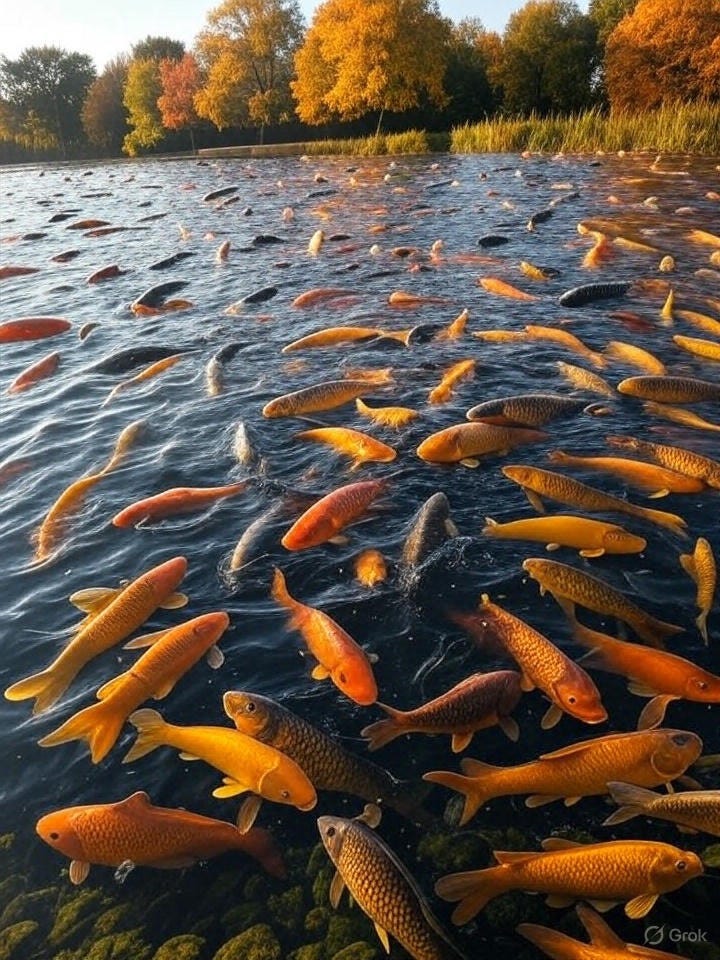
But that just is not so because human being change their environment all the time. They are not victims of it, but the creators, crafters and controllers of it. A fixed area of land on planet Earth may well only support some number of gazelle because no more grasses of a suitable type can grow there beyond some maximum limit. But if some patch of land can grow only so much wheat for flour for humans, we can change the calculus with vertical farming or with genetic engineering packing far more kilojoules of food energy onto an ever smaller patch of land.
For this reason the disparagement of “growth” is simply misplaced and based on a deep misconception. Because as the number of human beings increase on this planet, we do not tend to pollute the place or deplete the resources and make it all less habitable but rather the opposite. It becomes more habitable, less polluted and resources more numerous and cheap. And all of that happens because we create knowledge which occurs by correcting errors in what we know. The claim we make our environment less polluted and not more can cause a visceral emotional reaction in those heavily schooled in the environmental movement of the 1970s through to the present. But the fact is that planet Earth, the natural planet Earth, absent people is filled with pollutants of all kinds. Volcanic ashes and the eruption of dangerous gases, poisonous pools of water and streams into which washes animal dung and decaying bodies, airborne viruses and bacteria and allergens, dust storms and clouds of mosquitoes, as well as hazards too numerous to enumerate from earthquakes and tornadoes through to extremes in temperature and tsunamis and asteroid collisions.
Humans make safer and clear a more hazardous and polluted “natural” work. Cleanliness and sanitation is the “artificial” result of hard won knowledge created by people. It amounts to progress and allows for more rapid progress as people are healthier and live longer giving rise to the opportunity for the solving of more problems by a greater population of free individuals. Yet that entire story of positivity about progress is not well understood and so rejected by a great majority of the most powerful people on Earth: politicians, academia, the media, intelligentsia, technologists and of course: influencers. That “deep schooling” I mentioned may have begun in primary or infants/elementary school for many about the evil impacts of humanity upon a fragile environment but it persists for long after each time one turns on a newscast or reads a popular science article or goes to a movie somewhere. It is now the water we swim in. People reject progress of many kinds especially when that progress is implicated in some “side effect” like pollution even if the (very real) pollution is the result of solving some far more serious problem (take for example the pollution caused by the burning of fossil fuels to heat homes. Absent that pollution those homes would not be heated and people would again be dying across the developed world of cold by the millions each winter. That does not happen but only because energy remains, for now, cheap enough to keep homes and other places at a temperature high enough to prevent people dying of exposure).
There is much work left to do before a majority are persuaded that pursuing progress ever faster is itself an inherent good. That growth is good. That choosing to slow progress is a bad idea. But even that active choice to slow progress for the reason we should want to protect the planet so that it remain habitable for us, itself is motivated by deeper causes still. At base, progress is about correcting errors in the ideas we already have so that they are improved. Rejecting progress therefore is about avoiding the correction of errors and thus entrenching them. So the rejection of progress (or some proxy) is itself an error.
People do not in general deliberately make errors. They strive, sometimes with great effort, to avoid them and make things better - to make progress. But sometimes what they think is progress will cause regression - but they do not realise this because complex explanations, false (and often refuted) though they may be, persuade their holders they contain virtue. Humans, for example, depend upon a highly pristine natural environment and they, the humans, with their every action almost only ever cause damage to this environment. Therefore they should as far as possible minimise their impact on the planet if not for the sake of all other species on Earth then for self-interested reasons. After all, if the Earth becomes polluted it will become inhabitable. The logic seems inescapable, then: people should beware of progress. For progress (of a certain kind, like economic or technological) requires growth and growth requires energy and energy generates pollution which damages the very environment supporting humans. Though a prominent ideology that has captured much of global political discourse presently, it is far from being the only such falsehood slowing progress and which stands as an actual existential threat to humanity.
But how can a notion like “progress” which many see as an inherent good worth pursuing almost axiomatically be defended? We should begin with the notion that error correction of any kind is progress. But where are people going to notice progress of that kind most starkly out in the world if not in their own personal lives? In their ideas. People want to make progress in their ideas by correcting errors in them. In ideas about energy and how to keep warm, how to build more robust structures, how to move more quickly, or move more massive loads, or cooperate with ever larger groups of people, or transmit newfound knowledge further and faster or do science better or learn to learn better.
Any and all progress requires us at any moment in time to take our best ideas seriously, then find some fault with them, and repair it, making our overall “knowledge situation” more robust; more resilient (by the measure it will tend to be copied more widely and for longer and avoid being destroyed accidentally or deleted purposefully). Finding fault means identifying an error and once an error is identified then we want make the relevant repairs - in other words correct that error. Should we cease correcting errors as rapidly as we can then the doomsday scenario alluded to in the first sentence of this chapter begins. Progress first slows. Then stops. And then regression to an earlier more error-riddled time returns. After that: death and extinction await. It has happened before more times than we have chronicled for we only know a fraction of all the dead civilisations that have gone extinct on our planet alone. Who knows how many flickering flames likewise of other species able to generate explanations about the world beyond the Earth have suffered similar fates?
How can we avoid slowing the rate at which we correct errors? We must not destroy the means of error correction. There are many means of error correction and it is impossible to provide an exhaustive list nor define them precisely as a category because new methods can be created. Science is a great engine of error correction in our explanations about the physical world. Mathematics is a means of error correcting our ideas about the abstract world of necessary truth. Philosophy concerns itself with ideas in the deepest and broadest sense so there argument is the means we use to compare one idea with another and locate mistakes in reasoning or absurd conclusions or perhaps appeals to the supernatural or attempts to circumvent the laws of physics and so on. In morality we look for what is best in terms of what to do next or what should be done and if some prescription routinely calls for coercion, or suffering or impoverishment and so on these stand as errors in those theories and can be criticised on that basis. And so on it goes. But notice one thing uniting all of these domains of inquiry into reality we have mentioned from science and mathematics through to philosophy and morality (and we may well add politics, economics, art, engineering, technology and so on for all places where progress is actually possibly in the affairs of people) - all of these areas being domains of ideas require the idea actually be able to be expressed in the world. Spoken allowed or written down. If that cannot happen then there is no hope of critiquing the idea and thus no hope of identifying an error much less correcting one. Therefore we cannot hold an idea immune from criticism if we wish to identify errors in it.
How are ideas held immune from criticism in our world? How is progress prevented in some domains? Here is one way: make it either illegal or socially awkward (possibly even socially devastating) to discuss the idea. This is why free expression is at base a fundamental requirement for a dynamic society that has any hope of achieving something like “escape velocity” from the surface of a single planet. And because objective knowledge is a means of explaining the underlying objective reality, just like that underlying objective reality knowledge itself is a unified whole. This is just to say: trying to cordon off some part of our enquiries about reality or about knowledge creation and saying “You can speak all you like about anything at all…except this tiny thing. This insignificant thing which represents only a fraction of a fraction of what is known” will in the long run grind all progress to a halt because it will entrench error. And that error will, again in the long run, be the thing that causes the extinction of the knowledge creating species. Variations of this have of course actually occurred. Versions of “do not criticise this text” on pain of death has slowed progress over and again or “Do not criticise the leader” in many autocracies extinct and extant. In any case what those places share is a curtailing of the freedom to express certain ideas. Maybe many ideas. And maybe even arbitrary ideas which become taboo only once created, and are then deemed unsayable or even unthinkable by the authorities. But freedom of expression is but one means by which progress is enabled. Not ensured, but rather given the opportunity to flourish.
There are three important related ways in which we error correct our way to a better world. These three are not necessary exhaustive but they are a start and should any one of them be curtailed the entire enterprise of knowledge and wealth creation is slowed. This triumvirate of the means of progress do not necessarily lead to a better state of affairs but rather only to the possibility of improvement. There are never any guarantees of success, but there are ways to ensure failure. Certainty of failure is guaranteed by destroying the means of error correction and so we should want to understand what the most fundamental means of social and personal improvement are.
The ways that allow for the possibility of improvement are in order of importance: Free speech, free trade and the free vote. Or in other words, freedom of expression, capitalism, and democracy. These three facets of our civilization emerge from the deepest known moral and epistemological maxim: to not destroy the means of error correction. And that maxim is the defining characteristic of what David Deutsch has called our tradition of criticism.
This is a unique kind of tradition as far as traditions go. Traditionally, traditions are all about keeping the same things happening year after year. The annual turkey for thanksgiving, the decoration of the tree each December, the Hajj, the opening of British Parliament by the Monarch every four years. Traditions are those things that remain constant over long timescales. But imagine a tradition of change. A tradition of criticising in a panopticon way everything that happens: other ideas and even other traditions. Now a tradition like that seems absurd but if anything is the defining characteristic of the culture that has emerged over the last 300 years in Western Enlightened nations it is that. And it is a tradition that helps ensure progress rather than all other traditions which maintain stasis.
In the next part we will delve more deeply into preserving these key means of error correction - how to protect our tradition of criticism.
Credit: The work of David Deutsch is inspiration for this piece. Read “The Beginning of Infinity” and “The Fabric of Reality” for more.
Love this!